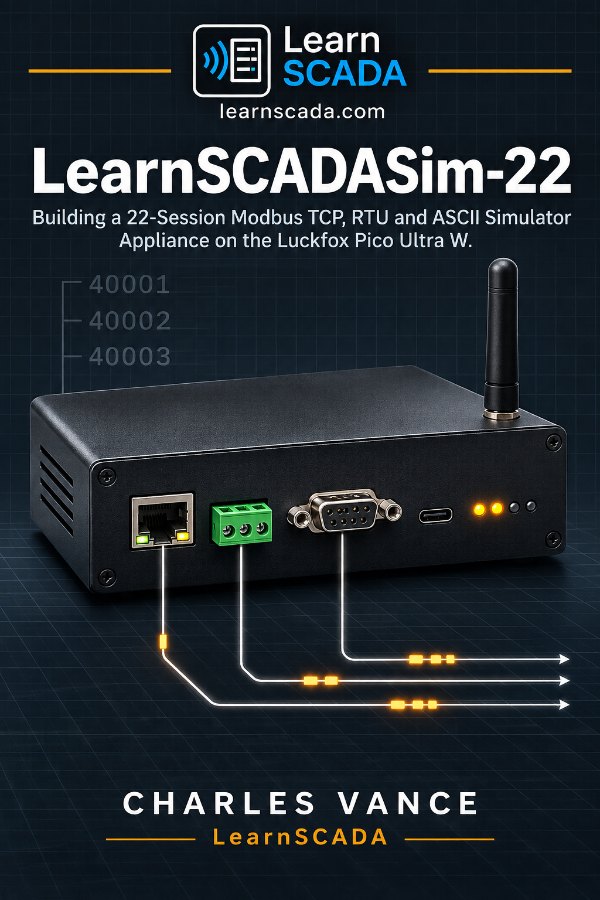
LearnSCADASim-22
Building a 22-Session Modbus TCP, RTU and ASCII Simulator Appliance on the Luckfox Pico Ultra W
Coming soon
A hosted simulator can answer Modbus TCP. It can never answer a serial
master. Yet much of the field still talks RTU over a twisted pair:
drives, power meters, flow computers and older remote terminal units.
When a serial link fails, it fails on framing, timing and port settings,
and the only way to learn those failures is to put a real device on the
other end of the wire.
LearnSCADASim-22 builds that device. On a Luckfox Pico Ultra W you will
build a small appliance that serves twenty Modbus TCP sessions over
Ethernet, each on its own configurable port, plus one RTU master on an
isolated RS-485 port and one ASCII master on an RS-232 port, all at the
same time and all from one shared datastore. Load any device from its
published register map through a web dashboard over Ethernet or WiFi,
and the device exists.
Every part of the book produces something that works. You write a
testable specification, choose and wire the hardware, put a hardened
Linux image on the board that survives being unplugged, and turn on the
serial ports in the device tree. Then you write the simulation engine:
the datastore and its behaviors, the TCP, RTU and ASCII servers, the
session manager that enforces the twenty-two slots, and fault injection
that breaks the link on purpose. The web interface adds a live register
view, port settings, map upload, a session list and a frame viewer.
Finally you load test the appliance at full budget and prove it against
Ignition, Modbus Poll and Python before packaging a release image.
What you will learn:
- Write requirements a test can fail, and trace each one to its proof
- Wire isolated, auto-direction RS-485 and an RS-232 DB9 port to 3.3 V
UARTs safely
- Enable UART3 and UART4 in the RV1106 device tree and settle pin
multiplexing
- Harden Ubuntu with a read-only root against power cuts and flash
wear
- Frame Modbus RTU and ASCII correctly: CRC, LRC, t1.5 and t3.5
- Serve twenty TCP sessions on one core without starving the serial
ports
- Load any device from its register map, several units on one trunk
- Inject bad CRCs, delays, exceptions and silence on purpose
- Build a browser dashboard, frame viewer, users and backup
- Load test, troubleshoot and package a release image
Written for automation technicians, integrators, controls engineers,
students and trainers who know what a holding register is and want to
build what sits behind one. Fully illustrated with detailed technical
diagrams, every requirement numbered and every build step backed by
copy-paste commands. A companion to Understanding Modbus, PLCSIM
Edition.
- Author
- Charles Vance
- Category
- Ignition and SCADA
- Trim
- 6X9